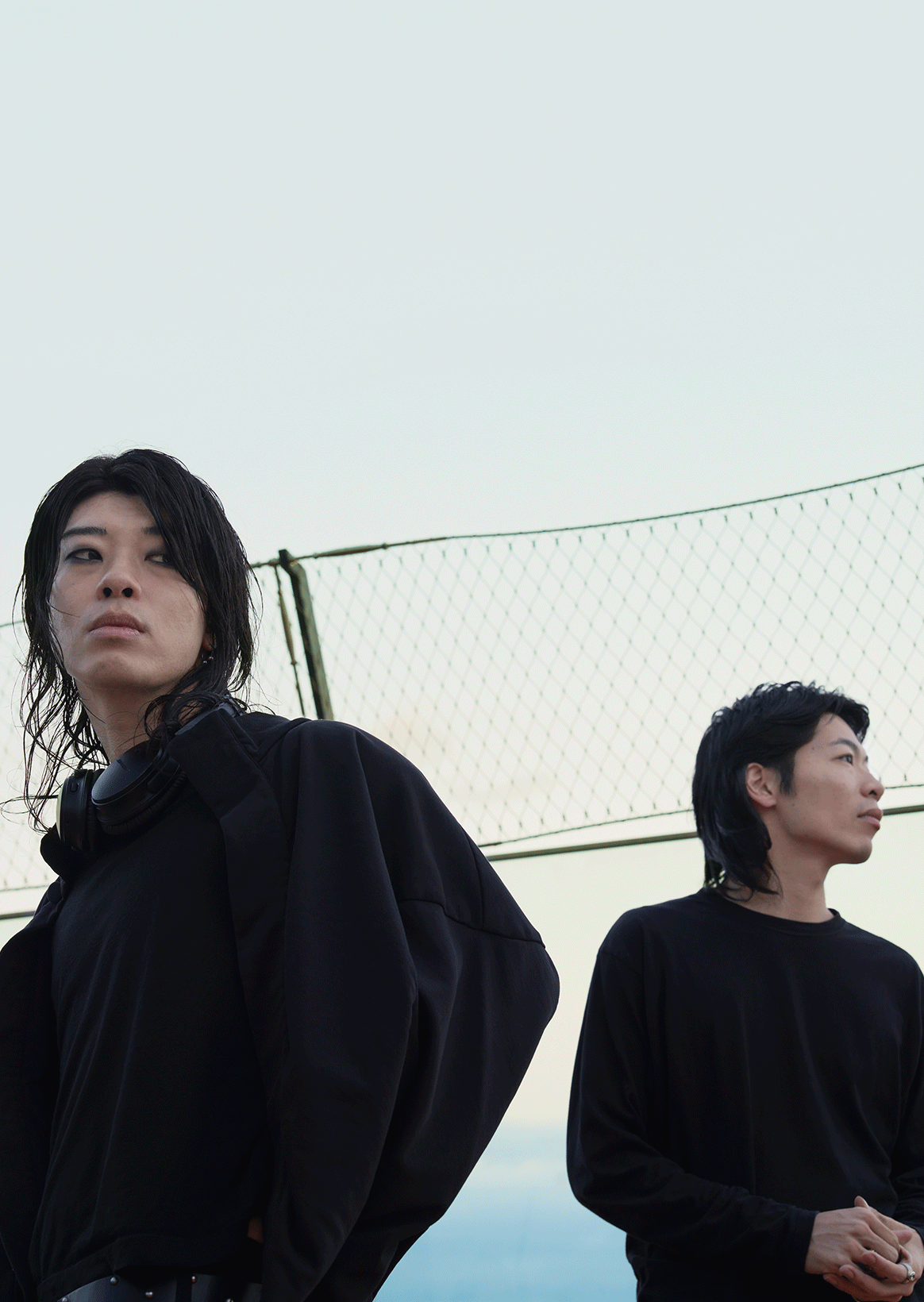
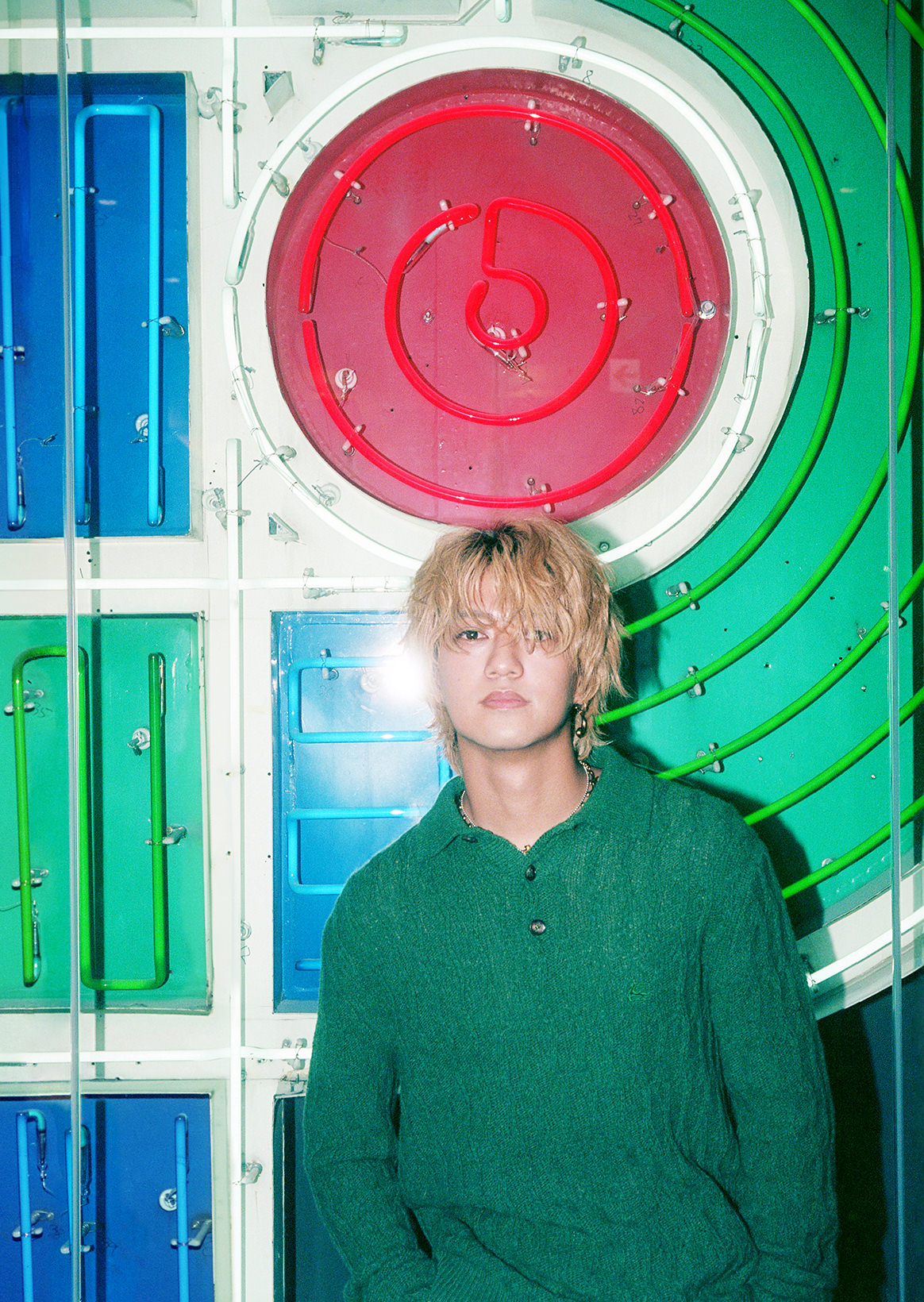
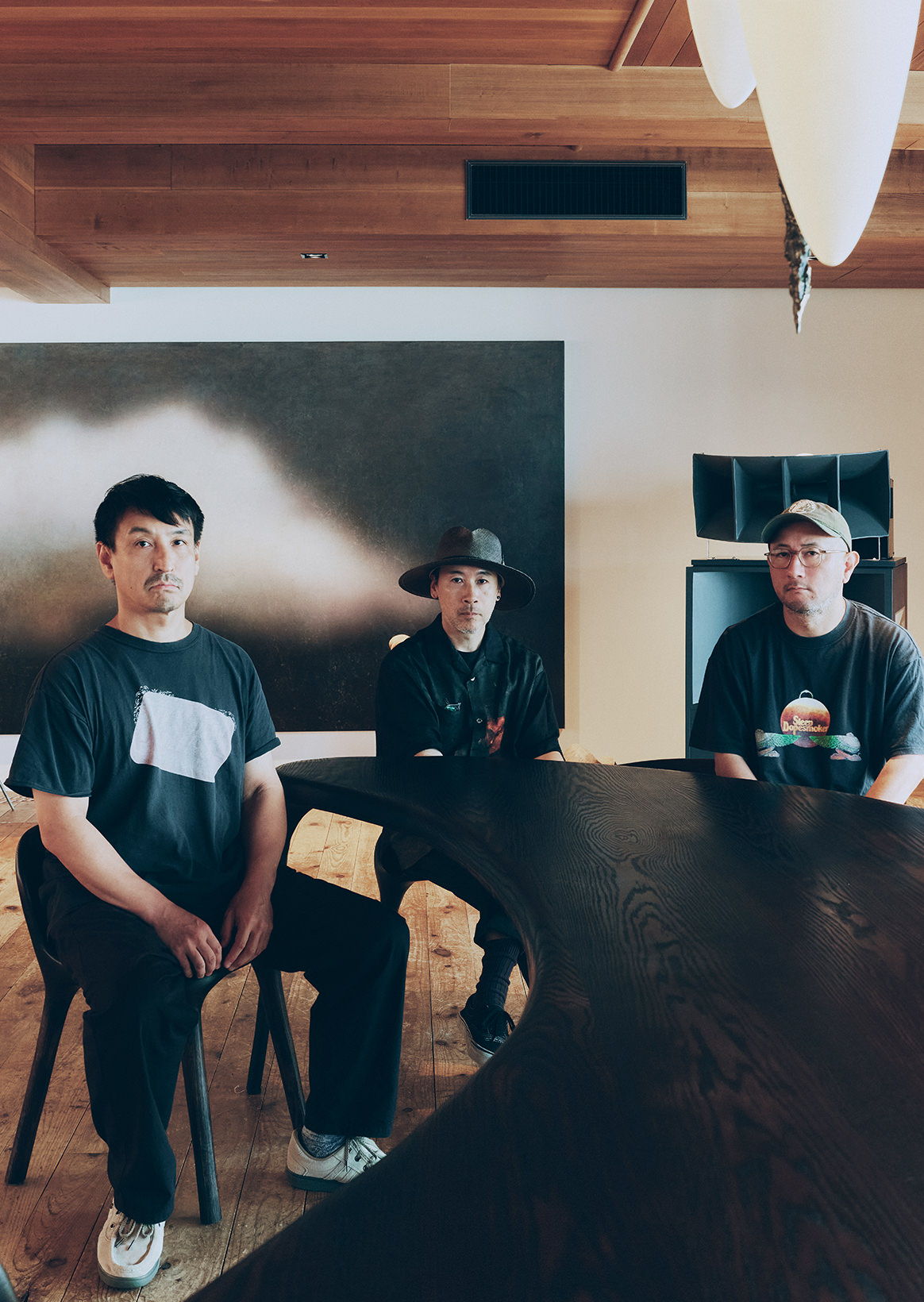
Shibuya PARCO is more than just a shopping mall; it's a place where culture is born and nurtured. This time, we feature Keigo Oyamada, who is in charge of the building's background music, as part of the lineup of renovations that truly reflect this history. Joining him are Takeshi Osumi and Yuichi Yoshii, who revived "WAVE," a legendary cultural hub in Roppongi that Oyamada himself frequented. What are the thoughts of these globally renowned musicians on Shibuya and PARCO? And what led these two, known as designers for MISTERGENTLEMAN, to revive WAVE, and what are their plans for the future? In this first-ever meeting, their teenage memories intersect, offering a glimpse into the foundations of their creativity cultivated during that time.
- Photo
- YUYA SHIMAHARA
- Edit
- Ryoko Kuwahara

—I understand that both Mr. Yoshii and Mr. Oosumi are big music lovers, and that Mr. Oyamada's presence was quite significant for them. First, could you tell us about the influence that the artist Keigo Oyamada had on your creative work?
Yoshii: "I've been a fan who's followed his activities all along. So I know he doesn't like it when we talk about things like that (laughs). I saw him in real time on TV shows during his early days, being asked boring, formulaic questions and completely ignoring the interviewer. On TV, mind you (laughs)."
Oyamada: "That was when I was young (laughs). Now I think it's embarrassing, and I'm fine now! How old are you, Yoshii-san?"
Yoshii: "I am 49 years old."
Oyamada: "So you're one year younger than me. How about you, Oosumi-san?"
Oosumi: "I'm 46 years old."
Oyamada: "They're quite a bit younger than me. You two run a brand together, right?"
Yoshii: "That's right. This is my seventh year."
Oyamada: "Do you each come up with the designs individually, or do you do it together?"
Yoshii: "The initial inspiration comes from Oosumi, and I often take that and expand on it. From there on, it's always been the two of us working together."
Oosumi: "Everything I throw gets edited by Yoshii (laughs)."
Yoshii: "My role is to figure out how to translate what this person is drawing into reality (laughs). Oosumi draws the initial big picture, and my role is to build the foundation from there. But now that I hear his age, I'm surprised to learn that Oyamada is one year older than me. He was already at the forefront of the industry when I wasn't even working yet, so he seemed like a huge senior to me. We were able to experience what Oyamada created in real time, and we felt like the times had changed, as if what was happening in the Western music scene was finally starting in Japan. I started listening to music with bands like JAPAN and YMO."
Oyamada: "Ah, that's right. It was a time when NHK would regularly broadcast live footage of JAPAN when I was in elementary school."
Yoshii: "Yes. Around the time when overseas fashion and culture were becoming interesting, works with such excellent aesthetic sensibilities started to be produced in Japan as well, and I watched them with great excitement. I couldn't help but enjoy them. And Oyamada was among them."
Oyamada: "Yoshii-san is also from the same generation, isn't he?"
Yoshii: "I was just watching from the sidelines as my peers started a movement (laughs). I had a mix of admiration, jealousy, and excitement."

—What were you doing at the time, Mr. Yoshii?
Yoshii: "I was a part-timer, and I was working part-time at a coffee shop in Shimokitazawa."
Oyamada: "My school was in Tsurukawa, and I had to transfer on the Inokashira Line, so I often went to Shimokitazawa. I used to hang out at a record store called Gobangai and the vintage clothing store in the same building after school."
Yoshii: "Tsurukawa! My family home is in Shin-Yurigaoka!"
Oyamada: "That's the station I went to every day. I used to hang out in Machida a lot too. There were a lot of delinquents there back in our day."
Yoshii: "That's right (laughs). You were that close by!"
—Did seeing that movement inspire you to create something?
Yoshii: "Yes. I couldn't take my eyes off everything about Oyamada, from his artwork to his presence, and the way the sound kept changing, transforming in directions that no one could have predicted, and the fact that there wasn't just one pattern, and that where it went seemed to predict the future. I guess you could say they're building a culture."
Oosumi: "I was listening to hip hop back then, but of course I was listening to Oyamada's music. I'm a little younger, so maybe there were parts I didn't see, but Oyamada's music just seemed to fit the word 'stylish.' I was at an age where I couldn't really understand whether something was good or cool, but I thought, 'It's stylish, so I have to listen to it,' and I would be one of the first to get the CD before everyone else and show it off."
Yoshii: "The word 'stylish' is a bit much, isn't it? (laughs) But that's exactly what it was. Even though I was at an age where my own values weren't fully settled, I thought, 'I have to be the person who likes this!' (laughs)"
Oyamada: "That kind of thing happens when you're a teenager, right? You try to act more mature than you are, absorbing all sorts of things without really understanding them, and that pays off later on."
Yoshii: "That's right. They act like they know everything."
Oosumi: "That was exactly how I felt, so when I saw Oyamada-san, I thought, 'I have to wear white denim.'"
Oyamada: "I have to wear white denim (laughs)"
Oosumi: "I feel like I have to do Delkaji and Kirekaji (laughs)."
Oyamada: "Yes, I found it (laughs)."
—(laughs). Mr. Oyamada, you're in charge of the background music for Shibuya PARCO this time. Could you tell us about the image you have of Shibuya PARCO that you have in mind, or any memories you have of it, which will likely form the basis of your music?
Oyamada: "I lived in Shinsen from around my second year of junior high school, so I was always around Shibuya PARCO, and I have many memories of the Book Center in particular. When I was a teenager, I worked part-time at Seed Hall, a space on the top floor of a Seibu-affiliated building that held art exhibitions, live performances, and film screenings. At the time, Kondo Toshinori's IMA Band was performing there, so I was helping carry instruments. It was around the time when illustrator Yoshida Katsu and Georgia O'Keeffe were holding exhibitions there."
—Were you involved in that project?
Oyamada: "No, it was just a part-time job. Tearing tickets, carrying instruments, and things like that. It was right after I graduated from high school, and I worked part-time for about two years while attending Setsu Nagasawa's Setsu Mode Seminar. I also started a band around that time, and when I was 19, Flipper's Guitar made their debut. So, when I was a teenager, I was heavily influenced by the Seibu culture of the 80s. We're that generation, aren't we?"
Yoshii: "Yes, it's very obvious."
Oyamada: "At that time, Shibuya was promoting culture. It was proactive towards new things, and Seibu, in particular, was a place that thoroughly introduced 'culture,' such as art, music, and movies."
Yoshii: "Back then, there was a trend of learning about culture through Shibuya. Mr. Oosumi, that was the era when you could blast your boombox on the Tokyu Toyoko Line, right?"

Osumi: "Well, I used to carry a boombox with me (laughs). But I also used to go to PARCO book centers to buy books. Back in the day, I used to rap. It was around the time Japanese rap was coming out, and there was a rap boom. And when it came to hip-hop, it was definitely Shibuya, so I went there every day."
Oyamada: "Yeah, there was also a hip-hop scene. Like Sanpin CAMP."
—Shibuya at that time was a melting pot of various cultures, wasn't it?
Yoshii: "Yes. Mr. Oyamada was right in the middle of it all."
Oyamada: "No, no, I was just an observer, and I think the generation that created that scene was much older. For example, Yukihiro Takahashi's Bricks-MONO was in Shibuya PARCO, right? And I think Shigesato Itoi and Eiko Ishioka were among the creators of Seibu culture."
—It's a tradition that's been passed down through generations. I had the opportunity to look at the November and December playlists of background music that Mr. Oyamada has created, and I got the impression that there were a lot of band sounds and lively songs that felt very Christmassy.
Oyamada: "We had Christmas in mind, and since it's a shopping mall, we decided that it shouldn't be too quiet or too noisy, and that the tempo should be somewhere between upbeat and mid-tempo."
—The background music will change every two months, but have you finalized the overall flow and image?
Oyamada: "I'm thinking of incorporating elements of the old PARCO and old WAVE. Like music from the 70s and 80s, the best era for PARCO. I'd also like to include some songs by Yukihiro Takahashi someday. I want to include a wide range of genres and generations, but since I was part of the generation when WAVE was around, and I think that's when PARCO's culture started, I think things from that era will be a basic part of it."
Yoshii: "I'm looking forward to it. How many songs will be on the playlist?"
Oyamada: "It's a little over three hours long, and it's probably going to be shown about three times a day. It will include original songs from all four seasons in the playlist, as well as music for the in-house announcements and the time signal, and we've also created an original ending theme that's similar to 'Hotaru no Hikari' (Firefly's Light)."
Yoshii: "Since we also run a shop, this is something that concerns me, but does music like 'Hotaru no Hikari' (Firefly's Light) make people feel like they want you to go home quickly? (laughs)"
Oyamada: "I guess I'll try to create an atmosphere that says, 'It's all over now, goodbye' (laughs)."
Yoshii: "It only plays once a day because it's at closing time, right? It's precious, isn't it? I bet there are people who deliberately come right before closing just to hear it (laughs)."
—I get the impression that you originally do fieldwork, recording sounds from various places. Are you also very interested in creating music that is appropriate for a particular location?
Oyamada: "I used to do that kind of thing. I don't do it at all now, but I do like it. I like sounds in general, not just pop music."
Yoshii: "Mr. Oyamada, are you a fast songwriter?"
Oyamada: "Well, I've gotten much faster through training. There's a program on NHK called 'Design Ah,' and I've been making the music for it for a long time, so I think I'm pretty fast when it comes to sound design and creating jingles."

—I'd also like to ask about WAVE. What was the reason you two decided to revive WAVE?
Yoshii: "Up until now, we haven't really done anything where the logo would pop up prominently in a show, but we were talking about creating a logo that would be a keyword connecting music and fashion, and we thought, 'WAVE's logo is made entirely of straight lines and it's really cool.' We started researching, 'Who should we ask if we want to use this logo?' and that's where it all began, and we ended up here without really thinking about it (laughs)."
Oyamada: "The day before yesterday, I met someone who used to run a label at WAVE. That record shop had excellent buyers, so there are still many famous people running record shops there today. Yamabe (Keiji), who runs a record shop called 'Los Apson?' in Koenji, was a famous buyer, and there was always interesting music in Yamabe's section, so I often bought things from there."
Yoshii: "That was back when people would buy music because 'this person recommended it.' My parents worked in Roppongi, and when we were going out for dinner, they'd tell me to stay at WAVE until they finished work. I used to hang out there with my siblings. I was in my third year of junior high school."
Oyamada: "There was a bookstore in the building too, so you wouldn't get bored."
Yoshii: "I wasn't doing it of my own volition, but I vaguely thought, 'There's always something good in this corner.' At the time, my older sister was studying in San Francisco, and she would send me cassette tapes once a month. They had popular music of the time, like Madonna and Duran Duran. That's how I got to know and become hooked on Western music through WAVE and my sister's cassettes."
—So WAVE holds some family memories for you. Did you also attend there, Oosumi-san?
Oosumi: "Ever since I moved to Tokyo, I've been going to buy rap and black music records."
Oyamada: "I lived near WAVE around 1994, so I went there almost every day during that period. When Koji Kikkawa appeared on 'The Best Ten,' there was an episode where he sang live from Roppongi WAVE, and he came down the escalator singing and dancing, and that footage is still on YouTube. Even now, when I feel nostalgic for WAVE, I watch that video (laughs). If you want to see what WAVE was like back then, that's the video to watch."
Yoshii: "I didn't know! (laughs) What song were you singing?"
Oyamada: "What was it again? Not 'You Gotta Chance'... Was it 'Goodbye is a Lullaby in August'?"
Yoshii: "Haha! There was a 'Yugara chance' after all (laughs)."

—Do you two have a vision for how you'd like to develop WAVE?
Yoshii: "Actually, as I mentioned earlier, we started out without deciding anything. But after we released our collection, a lot of people's feelings about WAVE suddenly came out."
Oyamada: "Oh, that's heavy (laughs)."
Yoshii: "Yes, it was even more overwhelming than I imagined (laughs). So from here on, I want to take my time and make sure that it properly reflects everyone's noble feelings."
Oyamada: "You had a store in Aoyama, right? I was walking around that area and saw the WAVE logo, so I thought, 'What's going on!?' Then I met Takimi-san and he was carrying a shopping bag, so I asked him why he had it, and he told me about Yoshii-san and the others."

Yoshii: "It was when we did a WAVE pop-up at Mr.'s shop and sold the T-shirts that were worn in the show. If we were going to sell T-shirts, I really wanted to recreate that shopping bag and put it in the package, so I searched for the original on Yahoo! Auctions and other places, but nobody had one. But Kenji Takimi had one! I thought, 'He's such a weirdo' (laughs). I borrowed it, and I couldn't just use a similar color, so I recreated it by creating the exact same color."
Oyamada: "Yeah, that's what's expected of us. WAVE has the feelings of so many different people involved."


Yoshii: "At WAVE in PARCO, we'll be selling T-shirts and other merchandise, but before that, we wanted to get people to know our name, so we gathered 400 modular synthesizers and built a wall, creating a place where people would want to take pictures and make memories. We also put vending machines along the street and made our own original WAVE canned coffee using almond milk instead of animal milk. But I'm a little worried that people might get angry about us turning WAVE into canned coffee. In the future, I want to create a place and expression where people can purely pursue music, so I'd love to talk to Oyamada-san about it!"
Oyamada: "Yes, if there's anything I can do."
 interview at QUATTRO LABO(SHIBUYA PARCO)

Keigo Oyamada
Born in Tokyo in 1969. Debuted in 1989 as a member of Flipper's Guitar. After the band disbanded, he began his career as Cornelius in 1993. To date, he has released six original albums. In addition to his own activities, he is also active in a wide range of fields, including collaborations, remixes, and production with numerous domestic and international artists.
http://www.cornelius-sound.com/index.html

- Shop name
- WAVE
- floor
- Shibuya PARCO 1F
- Items we handle
- Women's / Men's / Fashion Accessories / Music / Coffee
- telephone number
- 03-6455-2214
- Official brand website
- https://wavetokyo.com/
- Official Social Media
- @wave_tokyo
WAVE, primarily in the 80s and 90s, was a cultural hub that occupied an entire building, serving as a "new space for sound and visuals." Located where Roppongi Hills now stands, the six-story building housed a record shop curated with music from around the world, Cine Vivant, a mini-theater that boldly screened films not typically shown in mainstream cinemas, and studios for recording and computer graphics. It was a unique space filled with music and visual content, radiating an intellectual and sophisticated culture. In 2019, WAVE relaunched as a new project. It plans to disseminate information as a TEST HOUSE (laboratory) based on a mix of various cultures that go beyond just music and fashion. On November 22, 2019, a kiosk-style shop with the subname "MICRO WAVE" opened on the first floor of Shibuya PARCO.

- Shop name
- MISTERGENTLEMAN
- floor
- Shibuya PARCO 3F
- Items we handle
- Men's
- telephone number
- 03-6455-2399
- Official brand website
- https://www.mrgentleman.jp/
- Official Social Media
- @mistergentleman_aoyama
Launched in 2012 as a men's brand by the designer duo Takeshi Osumi and Yuichi Yoshii, the brand pursues the basic styles that the two prefer in their daily lives, proposing a new sense of balance in standard clothing, or "postmodern clothing," by adding a touch of unconventionality to the details, silhouettes, and coordination.