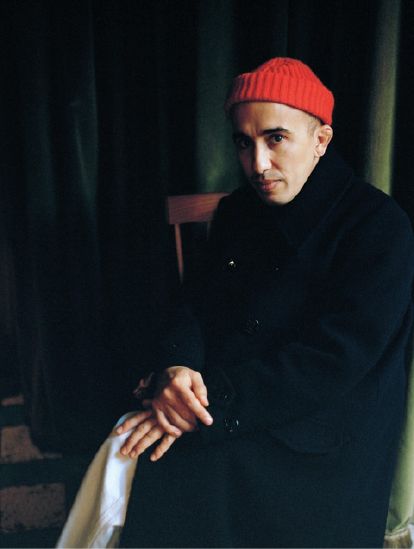
"I really like the concept of 'authenticity'."
In 2016, I moved with my family of five to Kagurazaka in Tokyo to open "OFFICINE UNIVERSELLE BULY" in Daikanyama. First of all, please tell us about the charm of Japan and Tokyo.
Actually, I've lived in Tokyo before. The reason I like Japan is... above all, because I can spend my time freely without being disturbed by anyone until 5 pm. It's truly heaven! When morning comes in Paris, I get so many messages that I can't do anything about it (laughs). Also, Tokyo has "otaku" in all sorts of genres. I really like that. To me, Tokyo seems less like a big city and more like a collection of countless small villages. I think it's amazing that there are so many otaku in all sorts of niche genres.
Have you ever experienced anything in Japan that shocked you?
The most shocking thing is that nothing shocking happens in Japan (laughs). When I went to a club called "ageHa" in 1999, seeing the gyaru girls dancing might have been the most shocking thing I've ever seen. Also, when I went to Chiba to cover a biker gang, I almost got kidnapped...
Are you going to cover a biker gang?!
I wanted to become friends with them (laughs). I wanted to hang out with them, so I asked them to do an interview under the guise of a formal interview. They were riding big motorcycles and carrying Japanese swords. I thought, "Wow! That's amazing!" (laughs). I'm really interested in this kind of Japanese subculture that you don't usually see if you're just going about your daily life.
Have any of your interesting experiences in Japan, such as becoming friends with biker gang members, served as inspiration for your ideas?
I really love the concept of "authenticity." When Japanese people create something, they strive to make the best possible product, to do their best, and I understand that mindset as "authenticity." I think that way of thinking, "Let's make something authentic," is wonderful. When things are made in Japan, there are always people who will spend an hour on even the smallest details. There are many times when you think, "Nobody will notice that, so it's fine...", but when you find that attention to detail, it's really impressive. At Shibuya PARCO, for example, even down to the logo on the toilets, the attention to detail is truly consistent, and I always think that's wonderful.
"Shibuya has changed a lot, but Shibuya PARCO will always be here."
What were your thoughts and feelings when creating the SHIBUYA PARCO 50TH ANNIVERSARY logo?
I'm a big fan of Takenobu Igarashi, the designer and sculptor who created the PARCO logo in the 80s. I have a lot of respect for his work. When I saw the logo that Igarashi created, it reminded me of the work of Cassandre, a graphic designer who was active in the 1930s. It was a really enjoyable experience to be able to create the 50th-anniversary logo while being inspired by senior designers that I respect.
These illustrations were created by "Art Recherche Industrie," the design company that also oversees the visuals for 10 projects at Shibuya PARCO from 1973 to the present day (2023). The illustrations, which reflect the changing times every five years, felt both nostalgic and fresh.
What I really wanted to do was pay homage to PARCO's advertisements from the 70s. I wanted to find the models from that time and shoot them in the same place 50 years later... but I didn't have the budget, so I expressed it in this way. The underlying message is, "Shibuya has changed so much, but Shibuya PARCO will always be here." The hippie movement of the 70s, the era of new wave punk, and the video games that took the world by storm in the 80s. Manga became popular in the early 90s, DJ culture was born in Shibuya in the late 90s, and during the bubble era, it was commonplace for everyone to take a taxi...and so on. The streets of Shibuya have changed so rapidly, and Shibuya's movements have come and gone...I thought that if I were to summarize the 50 years of memories that Shibuya, Shibuya PARCO, and everyone have woven together into 10 images, it would look something like this.
What kind of city is Shibuya to you, Ramdan?
The first time I went to Shibuya was in 1996. Back then, I used to hang out at "HARLEM" on Friday nights. There were so many clubs, but most of them have closed down now. I spent a lot of time hanging out in Shibuya at night, so I have many memories of Shibuya at night. But honestly, and I'm not just saying this to be polite, the reason I come to Shibuya now is because "Shibuya has PARCO." Shibuya PARCO has brands I like, such as "NEXUSVII.", all in one building. This time, I came from Paris without any clothes, so I'm thinking, "I have to buy a whole new outfit at PARCO!"
Shibuya PARCO is a place that can be enjoyed by people of all ages.
You don't have to search all over Tokyo for interesting brands; you can find and buy them all in one place at Shibuya PARCO. Plus, you can watch movies, see plays, and even eat delicious food! For a lazy person like me, it's a really convenient building.
"I believe there is nothing more liberating than the act of creativity."
I'd like to ask you about your creative process. Did you study design on your own?
I didn't go to school, so I guess I studied on my own. Starting design was really an accident. In high school, I made a T-shirt on a whim, and it worked out. It became a successful business. I call this event a "beautiful accident" (laughs). That's when I started to think, "Hey, maybe I have some talent." I think there's nothing more liberating than the act of being creative. All you use is your own brain. And you can even make money doing it all by yourself. In English, they call God a "creator," and I really think it's a godlike act.
Is there anything you value most when creating something?
What the client or the audience thinks...that's completely irrelevant to me. For the past 25 years, I've felt like I've just been working on impulse, but what I've always valued most is whether I like it or not. That's my only criterion for making decisions in my work. If I really, really like something, I can genuinely convince the other party.
The French candle brand "Cire Trudon," founded in 1643, was rebranded by Mr. Ramdane before opening "OFFICINE UNIVERSELLE BULY," and it was a great success. Did he handle not only the graphics but also the fragrance creation himself?
When I tried to start "Cire Trudon," I reached out to perfumers all over the world, but no one said "yes," and I couldn't find anyone to work with me on creating the fragrances, so I decided to do it myself. And it worked out really well, and the business became a success (laughs). At first, I made six kinds of candles and thought to myself, "This one will sell the most, this one will be the second best..." and it turned out that I was right. Those six kinds are still the bestsellers today. The success of "Cire Trudon" is the second "beautiful accident" in my life (laughs). I thought to myself, "I'm pretty good at graphics," but after working on "Cire Trudon," I discovered that "I'm actually pretty good at fragrances too" (laughs).
Is "OFFICINE UNIVERSELLE BULY" also based on the same kind of free-thinking approach that comes from believing in oneself? Buly's fragrances are made using exactly the same method, aren't they?
"I'd like to pat myself on the back for coming up with a really great idea!" That idea was to make perfume with water instead of alcohol. I also think it was a great idea to create a fragrance "for myself" rather than for other people. It was a major revolution in perfumery. And now that idea is being copied by everyone (laughs). But I'm fine! I don't mind if people copy it as much as they want. I have 100 other ideas, so I don't mind at all (laughs). Inspiration comes endlessly. I'm actually a little troubled by how my ideas overflow and are nonstop.
Where does your motivation for your work come from, Mr. Ramdan?
I don't know... I have absolutely no idea. I've never even thought about motivation. I'm not the type to think, "Why am I doing this?" I just do it. I don't set any medium- or long-term goals; I just try things out. If you set goals, you lose some of your freedom, so I think it's better not to have goals in order to enjoy it. Apparently, I look a little stupid to other people (laughs), so I think people who see me think, "If he can do it, maybe I can too." But I'm happy if they think that!
What do you enjoy doing right now?
When I think about it, the same answer always comes to mind (laughs). For me, the best moment is "five seconds before opening the box of a prototype." To explain it in a way that a younger generation can understand... it's like five seconds before you actually meet a really beautiful girl you've become friends with on social media (laughs). Her face in the photo might be heavily edited, but those "five seconds before" meeting her is the most exciting moment. You start to think, "If she looks just like this photo, that'll be amazing!" (laughs).
Finally, do you have a message for Shibuya PARCO's 50th anniversary?
For 50 years, they've been doing things that are completely different from other stores. If they continue doing things the same way, I think that even after another 50 years, Shibuya PARCO will remain a unique store unlike any other. If I'm still alive at 80 and I like cool things then, I want Shibuya PARCO to be a place where people think, "If I go there, I can find something interesting."