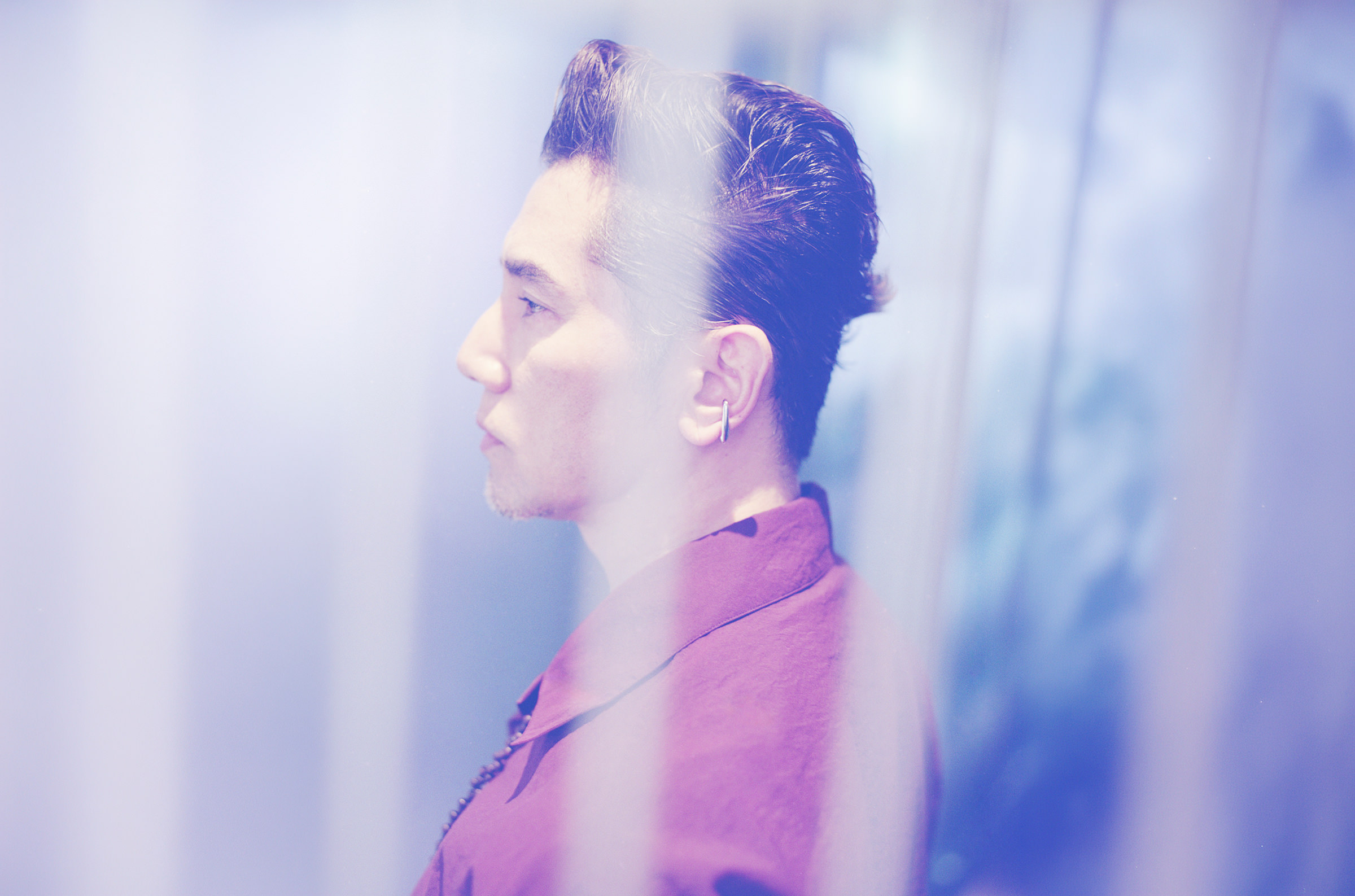
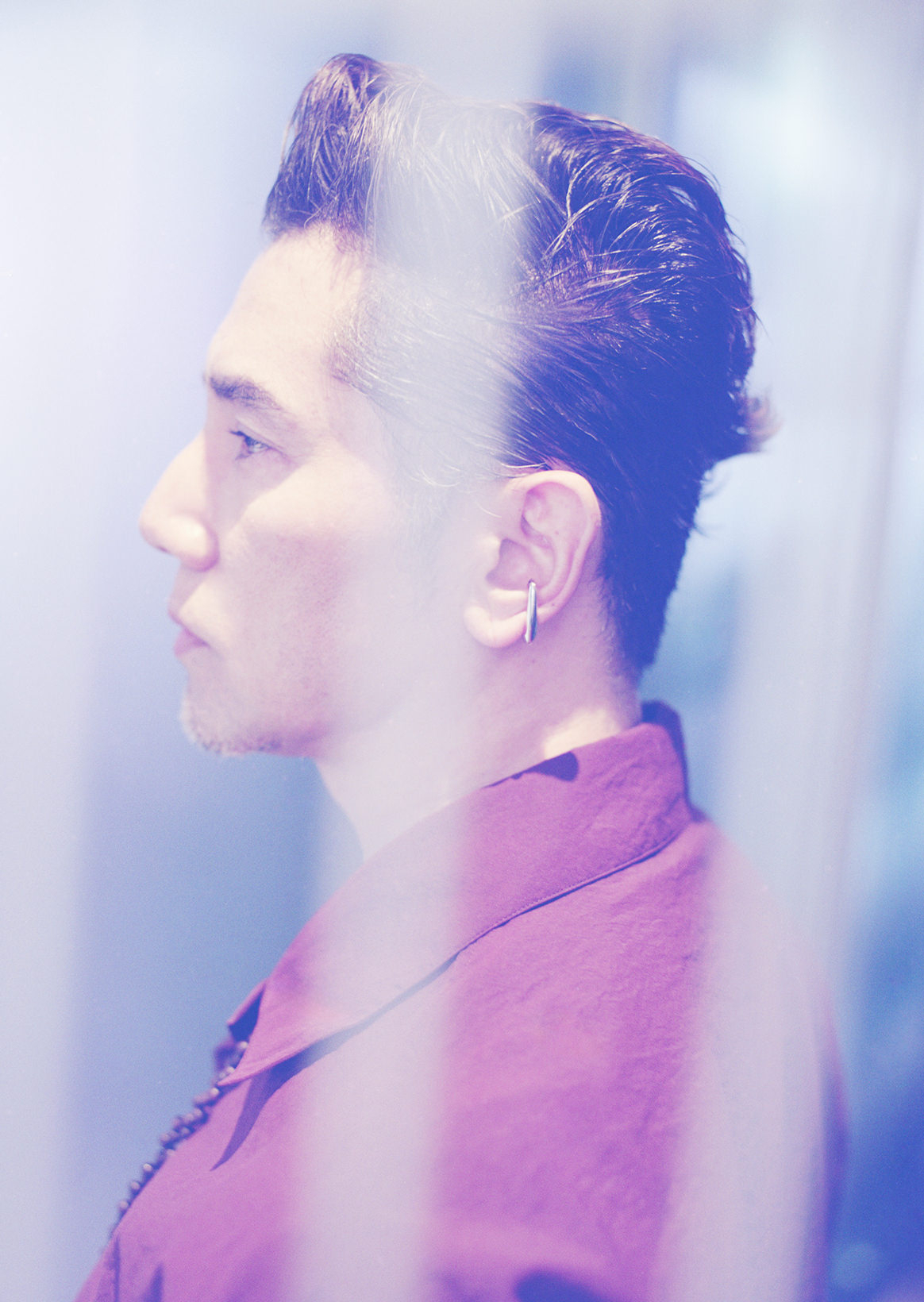
Masahiro Motoki, who has reached the milestone of 60 years in life, revisited his own journey with the photobook "awai: Moments and Eternal Manima," released on June 12. From June 11 to June 21, an exhibition was held at "NONLECTURE books/arts," a new hub that bridges books and art, born on Shibuya Spain-zak. This photo book is revisited by Kazuhiro Nakamura, a longtime friend who traveled India with him when he was 27, after more than 30 years. The numerous photos taken while traveling through Kyoto, Tokyo, and London overlap with Motoki's own words, quietly capturing the present and past, actor Masahiro Motoki and the individual Masahiro Uchida, and the time dwelling in that "Awai."
- Photo
- Taka Mayumi
- Text
- Hisako Yamazaki
- Edit
- RIDE Inc.

"Undoubtedly, the morning of the 60th anniversary, indeed"
"Has anything changed?" — Masahiro Motoki
On the morning he turned 60, the photobook "awai: In the Midst of a Moment and Eternity" begins with a quiet gaze upon Masahiro Motoki, now 60 years old. The photographer who took that gaze is Kazuhiro Nakamura, who has known him since his twenties. The two were also companions who traveled to India together when they were 27 years old. It was a thoroughly analog journey, before information was readily available, with maps in hand, filled with both anticipation and anxiety about the unknown. What they witnessed there were the hazy outlines of life and death, landscapes where everyday life and prayer coexisted, and numerous shocking experiences that shook their values. The images of Motoki that Nakamura took during that time culminated in the 1983 photobook "HILL HEAVEN: Sitting in the Sky."
The journey became a starting point for the two of them.
Then, more than 30 years later, they would meet again at a turning point in their lives. The catalyst was a meal they shared after a long time, when Motoki was staying in Kyoto for the filming of the movie "Black Prison." As they rekindled their old friendship and reminisced about old times, Nakamura casually said, "Would you let me take your picture again?"
The idea of creating a photobook wasn't there from the beginning. The two, having reached their sixties, faced each other again after more than 30 years, wondering what would emerge when the same people looked at the same person again. That expectation gradually transformed into a small adventure.
"I had a feeling that something insightful might emerge when the same person, after 30 years, looks at the same person again," Motoki said.
Like the time shared during past journeys, the photographer travels to different locations, embracing chance and taking repeated photographs. This process itself forms the core of the book, "awai." In life, there are moments when we reconnect with things after time has passed. This photobook teaches us about the wonder and richness of those moments.
—On your last night as a 59-year-old, and the morning you turned 60, what were your thoughts at these two moments? Also, how did you spend your 60th birthday with your family, and what kind of conversations did you have?
The morning scene in the photobook, where I'm in my bed at home, is a real depiction of the morning I turned 60. It felt like just another ordinary morning... but it made me realize that this is something you really do reach. I also had the feeling of aligning life with the flow of time in my imagination.
To be honest, I don't remember what I was thinking the night before, my last night in my 50s. I did have a photoshoot planned for the next day, so I guess I was just hoping that everything would go smoothly... On the day of the shoot, I put on a red shirt and tailcoat jacket, grabbed a red scarf, and headed out onto Chuo-dori in Ginza to carry out a guerrilla photoshoot. It was still early in the morning when there weren't many people around, but a crowd quickly formed... I was actually hoping to blend in with the crowd and stand out, but everyone quickly moved aside and made way for me (laughs). Even so, I'm sure that when I look at it 20 years from now, it will be a strange photograph that captures the essence of Ginza at that time.
In the evening, my family and people from the office gathered for a celebratory dinner at my favorite fancy Chinese restaurant. Photographer Nakamura also dropped by, and the photos of me holding the portrait my second son drew for my 60th birthday, as well as the only family photo included in the photobook, were taken that night. In England, a 60th birthday is called "DIAMOND JUBILEE," so my family gave me a card with sparkly stones on it, but the message was quite mundane: "Keep walking regularly to maintain your health" and "Try to keep your surroundings tidy" (laughs).


Between a fleeting moment and eternity
Masahiro Motoki's perspective on "the in-between"
The title "awai" was born from a casual remark made by the editor.
"When I look at Motoki-san, I feel like he's moving between different time periods. I sense a 'space in between' there." — The past and the present, Motoki Masahiro as an actor and Uchida Masahiro as a person. A sense of wavering between them. That feeling became the phrase that symbolizes this photobook.
Photographer Nakamura describes the appeal of photography as "the transience of never being able to capture the same thing twice, the things that exist only in that moment." These words somehow resonate with the meaning inherent in the title "awai." Time flows constantly, and things are always changing. The same moment never comes twice, and people, too, are constantly changing. Perhaps it is this transience and richness, and the fleeting brilliance that emerges amidst the transience, that is the world that the word "awai" refers to.
"Things are constantly changing and moving, and you never know where you're going to end up," Motoki says.
—What does the word "awai," which is also the title of the photobook, mean to you, Mr. Motoki? Also, what is the "awai" that you find most appealing in recent years?
"Awai" exists in the spaces between things, between people, between the past, present, and future, and in the changing seasons. It's a Japanese word written as "間" in kanji, but it doesn't simply mean "between," but rather the space where things mix together, or the part where they blend together. Everyday conversations and plays also convey nuances through this "間." To be more precise, even in the silence before and after we speak, in the lingering resonance, something invisible touches each other, creating "awai." When you think about it that way, it makes perfect sense that "human beings" are made up of "間 (awai)" that connect "people." I want to share that with all of you.
For me, the greatest joy is undoubtedly found in the many films and other works I've left behind. As an actor, the time spent filming is proof of my existence, and when I watch my works, the moments from that time inevitably flash back, and I also receive the universal message of the story... In other words, reality and fiction = myself and others = Masahiro Motoki = Masahiro Uchida are all fused together, truly "at the mercy of a fleeting moment and eternity." I can gaze upon and savor the moments that float up or are imprinted on my memory.
—The back cover says, "Finding the presence of invisible things and the light in the faint of the light is the key to imagination." What was the "invisible thing" that you were most strongly drawn to, or whose existence you felt most strongly, Mr. Motoki?
This is not flattery, but I was drawn to the atmosphere and concept of NONLECTURE, which I had the pleasure of encountering this time. First, I was surprised to find such tranquility amidst the hustle and bustle of Shibuya. Then, there is the concept of not being bound by form, but allowing people and expression to intersect through books, art, and events, and not just consuming, but capturing and accumulating the sensibilities that arise from the place, thus leaving behind layers of the city's cultural memory. The description of it as "a place where you can spend time freely like in a field" evoked feelings of nostalgia and curiosity, and I felt the incredible depth of Shibuya.
Descending underground, the surprisingly spacious, high-ceilinged area resembles a cavern. It's a joyful feeling, like discovering a spring that has been flowing since ancient times... I'm secretly excited by the thought that the exchanges that take place here will surely lead to something new, stimulating and coloring the world, and resonating in some way...


—— The photo exhibition "NONLECTURE books/arts" is located on Shibuya Spain-zaka. What memories do you have of the city of Shibuya and Shibuya PARCO for you, Mr. Motoki?
Since the 1980s, when I was a group singer, Spain-zaka was a charming spot popular with young people, so I used to do magazine shoots and record dramas from night to early morning on the stairs. In the 90s, I watched cinema-based and niche directors' works and art movies on the hilltop, and also watched various things at the PARCO theater. For example, I saw punk ballet jockey Michael Clark's Japan tour. Also, back when PARCO Book Center was around, I wandered around the area with foreign book art books and photo books, buying favorites and beautifully bound art books with unique concepts for gifts. Tower Records relocated to Shibuya around the 1990s, and I checked out clothing stores on Fire Street — vintage, street, and natural styles...... It feels like I was moving through cultural stimuli including sub-production. During my time when I was married and raising children, I spent time searching for interior goods, household goods, and children's clothing, and since I have lived in the Daikanyama and Shibuya areas since I was 19, I have a strong attachment to what you call living within my living area. This spring, I also saw the wonderful exhibition of Yuriko Takagi's photo exhibition 'Threads of Beauty.'

After a gap of 30 years,
Encountering another version of myself in a photograph
Filming for the movie "Black Prison" was carried out in between shoots. Starting in Kyoto, the setting for the film, the journey continued for about four months, moving to Tokyo and London, visiting places that have been important to Masahiro Motoki in his life.
Turning the pages reveals not only a current image of Motoki, but also photographs taken in India when he was 27 years old, during a trip with Nakamura, which quietly resonate with his current portrait, separated by more than 30 years. Furthermore, this book is composed not only of photographs, but also of Motoki's own words. As he says, "Weaving words together gave me an opportunity to reflect on myself," and there, the image he portrays as a subject and the words he uses to look inward overlap.
—This time, working with photographer Kazuhiro Nakamura for the first time in 30 years, were there any expressions or appearances of yourself that surprised you? Were there any "unknown aspects of yourself" captured in the photographs?
Since it was also during the filming of the movie "Black Prison," I think it's fresh and valuable to have been able to record the bearded look I had grown for the role. Thanks to that beard, I think I was able to project a sense of aging, even though I'm usually mistaken for being younger than my actual age. When a camera is pointed at me, I instinctively try to present myself in a presentable way, so it's difficult to be completely unguarded, but that conscious self is also a part of reality, and I'm certain that I was closer to my usual, laid-back self when I was in front of my friend Nakamura.
It's not just one particular photo, but for example, in the London series, I feel a sense of liberation in a foreign country, and at the same time, I'm reaffirming my own modest existence. In that sense, I feel like it captures something closer to my true self than the person I am when I'm in Japan...


Finally, I am connected to the earth.
Masahiro Motoki depicts the life that lies ahead.
Now that he has reached the milestone of turning 60, how does Masahiro Motoki envision his future path? Having spent a long time confronting himself, he says, "I finally feel like I'm connected to the earth in a normal way." His words reveal a quiet sense of realization that he is striving to live a grounded life as an individual, transcending titles and roles.
"awai" is a book born from reflecting on one's own journey and re-examining the accumulation of time. "I've become able to look at myself more thoroughly than before. I want to share that with everyone"—for Motoki, this book is not just a photo collection documenting his 60th birthday. What is embedded within it is a desire to share the richness of time that he has come to see through looking at himself, and the feelings that reside in the spaces between people. And perhaps, in some way, the journey of life that Motoki has walked will resonate and overlap with the journey of each individual reader. Such thoughts are also entrusted to this book.
And Motoki continued:
"I don't mind encounters, unexpected events, or being pushed forward by others. I guess I like the feeling of being carried along by them and being thrown somewhere."
Being carried away to places yet unseen, surrendering to chance encounters and unexpected events—that feeling has been the driving force that has shaped my life so far, and it may be something that will continue beyond the journey of 'awai'.

—What kind of person do you want to be going forward, Masahiro Motoki? And what values do you want to cherish in your life?
In terms of overall image, I want to become a person who is calm, yet possesses a resilient strength. And I want to cultivate the capacity to find enjoyment in situations that don't always go as planned...
Work and daily life rarely go according to plan. However, unexpected discoveries and guidance can be found within that disarray, and I believe that accepting these discrepancies broadens one's horizons.
The character for "creation" (創) can also be read as "wound" (傷). In other words, creation begins with "making a wound." When a small crack appears in your heart, if you carefully examine it, a small imagination may emerge... If you think of that as a sign that it leads to a big opening, your anxiety will turn into a quiet hope... The ideal is to become an adult who can deal well with the invisible "heart" in this way.


Information

Author: Masahiro Motoki, Kazuhiro Nakamura
Photo: Kazuhiro Nakamura (Kazuhiro Nakamura Photography Office)
Text: Masahiro Motoki
List price: 6,050 yen (5,500 yen + tax)
Specifications: A4 size (modified) / Landscape orientation / Codex German binding
INBN: 978-4-86791-089-4
Published by: Two Virgins Co., Ltd.

- Shop name
- NONLECTURE books/arts
- floor
- OTHER
- telephone number
- 03-6455-1377
- Official brand website
- https://nonlecture.jp/
- Official Social Media
- Instagram(@nonlecture_books_arts)

Masahiro Motoki
Born in Saitama Prefecture in 1965. Actor. He won the Japan Academy Prize for Best Actor for the film "Sumo Do, Sumo Don't" (1992). Since then, he has appeared in numerous popular works, including television dramas such as the NHK Taiga dramas "Tokugawa Yoshinobu" (1998) and "Saka no Ue no Kumo" (2009), as well as films such as "GONIN" (1995), "Tokiwa-so no Seishun" (1996), "Gemini" (1999), "Japan's Longest Day" (2015), and "The Long Excuse" (2016). His starring film "Departures," released in 2008, won the Academy Award for Best Foreign Language Film at the 81st Academy Awards, attracting worldwide attention. His starring film "Black Prison" is currently showing. The drama "The Man Who Carries the Voice of August," commemorating the 80th anniversary of the end of the war, has been made into a film and will be released in the summer of 2026.