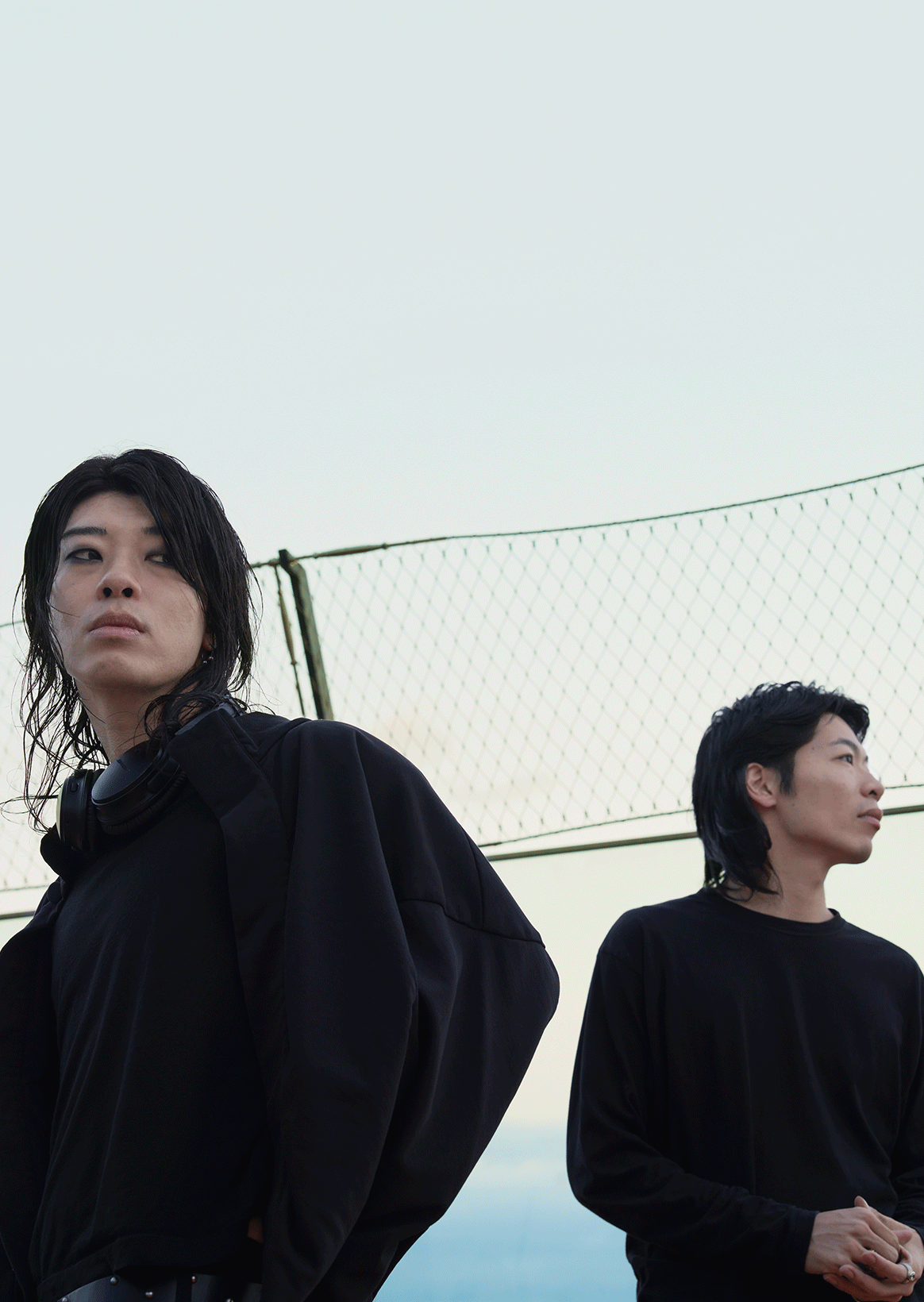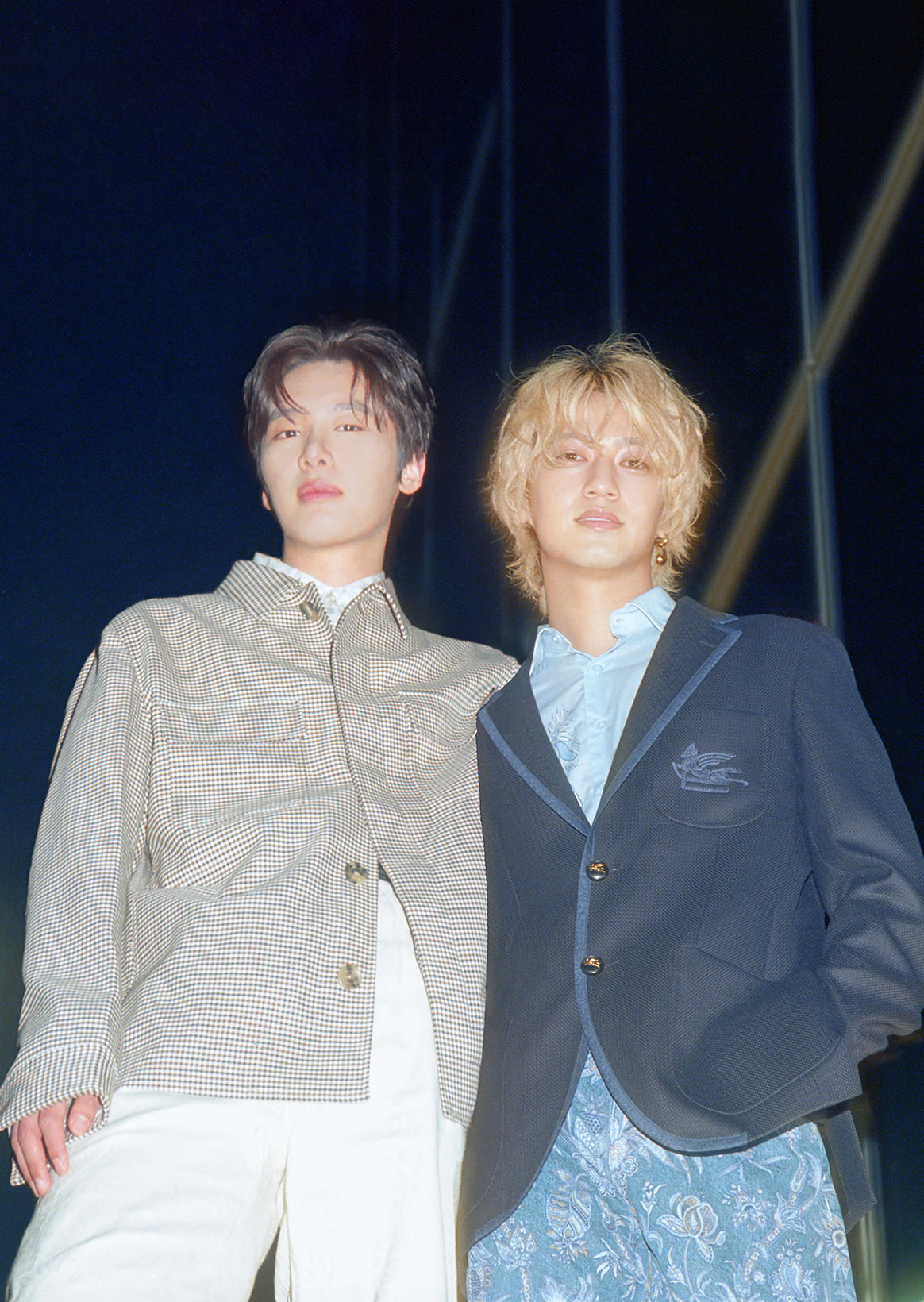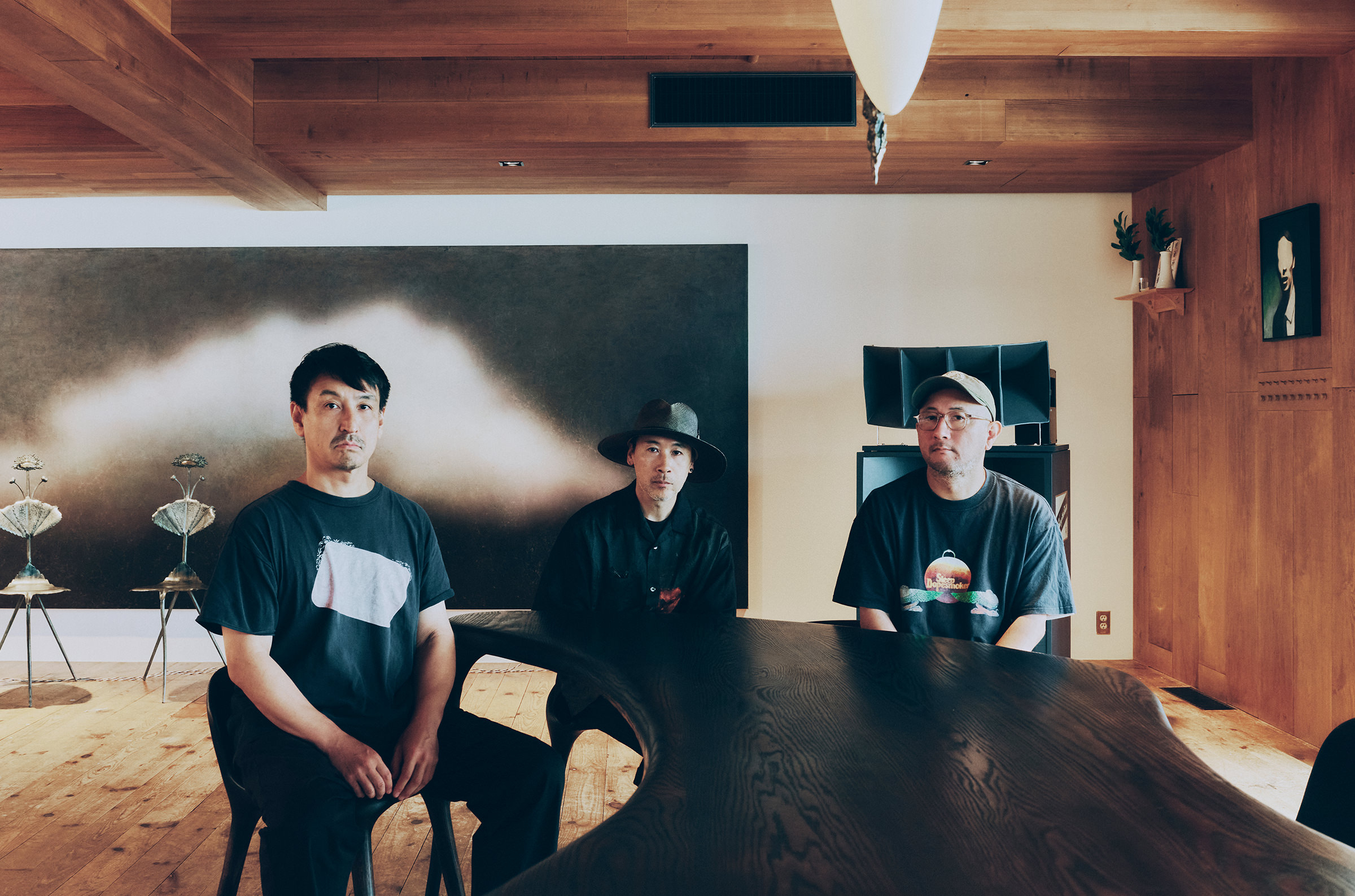
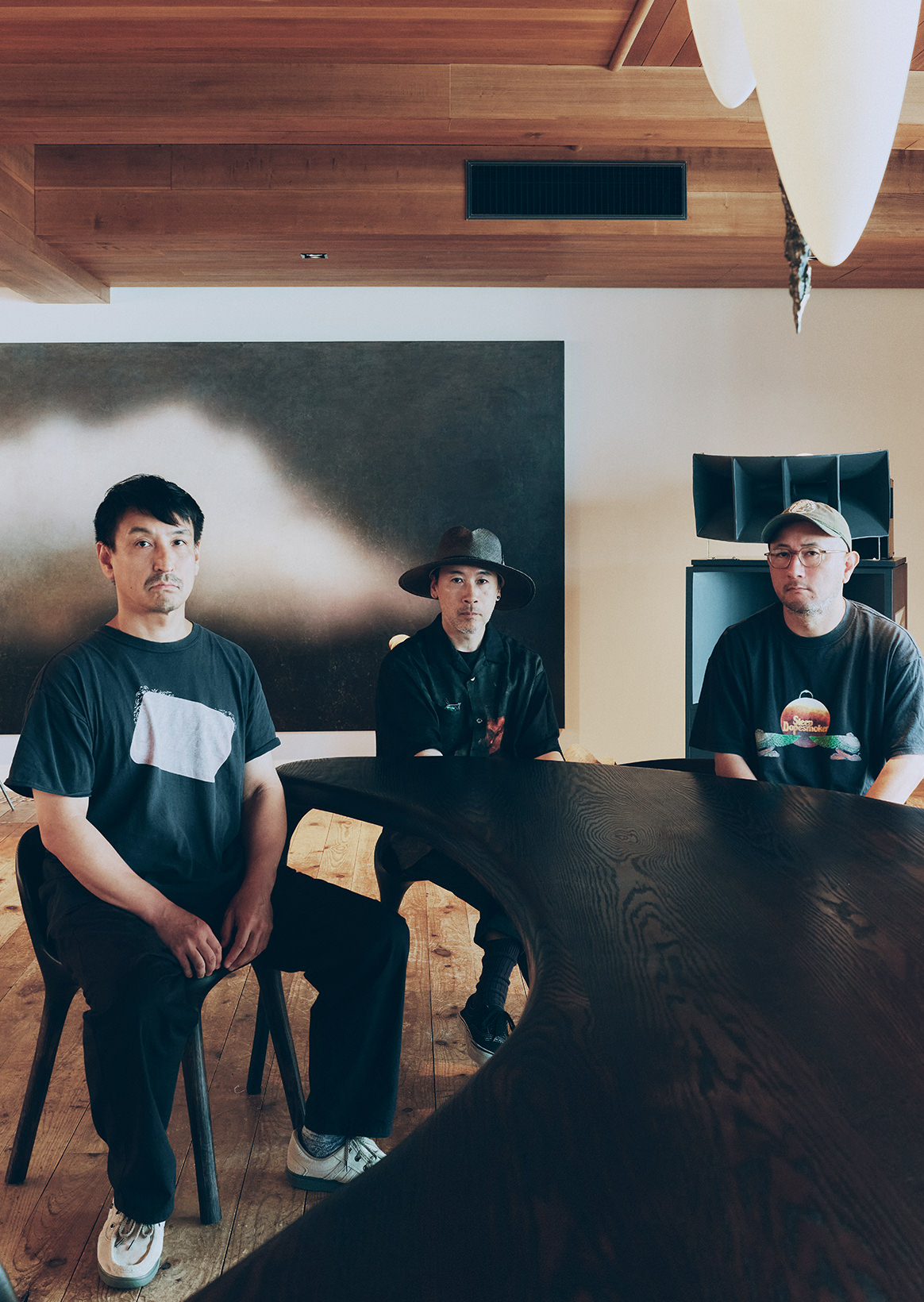
Approximately 15 years have passed since the release of the art book "UNDERMAN" in the Spring/Summer 2011 collection. Now, a video work has been completed depicting the trials and tribulations of UNDERMAN's daughter as she strives to become "UNDERGIRL," her father's successor. How did Jun Takahashi, Tetsuya Nagato, and Katsuhide Morimoto, who have continued to create works across various fields such as clothing, photography, graphics, film, and special effects, bring this fictional hero back to life? We spoke with them about everything from their first meeting to their new image of a hero who "doesn't fight," how they use clothing as a key element in the story, and their experiences on set with the actors.
- Photo
- Ryo Nagata
- Text
- Hiroaki Nagahata

—First, could you tell us how you all met and how you started creating things together?
Takahashi Morley (Morimoto) was originally an assistant to Yoshie Tominaga (who was in charge of photography for UNDERCOVER).
Morimoto: At the time, I wasn't directly present at the photo shoots, but after I went independent, Mr. Tate (Takahashi) contacted me several times for magazine features and such. Initially, there were shoots in Tokyo, and eventually I was invited to the backstage of the Paris Collection, which Mr. Tominaga was photographing. After working on projects such as 'A MAGAZINE,' which Mr. Tate edited, the first long-term collaboration I had was on the photobook 'GRACE.'
Takahashi: It was 2008, so it's been almost 20 years now. I think our relationship changed significantly with 'GRACE'. Instead of simply photographing clothes, we started thinking about a story together and incorporating visual elements into the photographs. That's where the way we create things, which is also connected to this 'UNDERGIRL', began.
I met Nagato Morimoto around the time I released 'GRACE', right?
Nagato: That's right. Through another job, Morley introduced me to Tate-san, and I showed him my exhibition and we had drinks together. Soon after we met, I participated in the planning of "FIGARO japon" and "smart," which were spin-offs of "GRACE." About two years later, "UNDERMAN" began.
Takahashi: The three of us came up with the story for 'UNDERMAN'. Later, Taro (Mizutani) joined us, and that led to what is now UNDERCOVER PRODUCTION.
—What do you think is the reason these three have been able to continue creating things together for so long?
Takahashi: I wonder. We all have slightly different cultural backgrounds and areas of expertise, but we all have an amazing ability to delve into a single idea and expand on it. And we're all similar in what we find interesting.
Nagato: However, the direction in which we're developing these things is slightly different.
Takahashi: That's right. Because we're all different, it's always refreshing to hear other people's opinions. Of course, if I disagree, I'll say so, but then I get even better ideas in return, so I can honestly think, "Okay, let's go with that."
Morimoto: I think what we like is not for each of us to stubbornly stick to our own domain, but to work towards something that we haven't yet seen.
Takahashi: Also, surprisingly, everyone has common sense (laughs). They don't just say outrageous things, but they can think concretely about what steps are needed to make that happen. The only thing they tend to overlook is money, I guess.
Nagato: That wasn't the goal in the first place.
— Looking at the credits for 'UNDERGIRL,' it's clear that it's not made in the way that a single director is at the top, as is typical for movies.
Takahashi: Oh, right, who's the director?
Morimoto: That would be me.
Nagato is supervising this project, right?
Morimoto: That's true, it might be different from what a typical director is. In a normal film, the roles of director, cinematographer, and producer are clearly defined, but many of us work across different areas, so it's not a top-down structure; everyone appears to be on equal footing.
—This project follows on from the flow that began with 'GRACE' and continued with 'UNDERMAN'. But why did you choose a format other than a runway for 'UNDERMAN' in the first place?
Takahashi: Ever since I started putting on shows in Paris in 2002, I've periodically questioned the runway. People come out, music plays, and clothes are shown. It's the most effective method, but there are moments when I think, "What is this all about?" Before that, I had the experience of curating an issue of 'A MAGAZINE,' where I shaped creations other than clothing. Furthermore, the sense of accomplishment from creating 'GRACE,' and the experience of being invited to Florence afterward to try out presentations that went beyond the usual runway, also remained with me.
While still incorporating clothing, I wanted to showcase my creations in ways other than fashion shows. However, even holding a photo exhibition at Paris Fashion Week didn't really resonate with people. Everyone was there to see the fashion shows, so they just glanced at it, thinking, "They're doing something different," and that was it. Still, I felt that unless I showed something other than the runway, people wouldn't get to know the brand more deeply, including my love for special effects and fantasy. That's why I released "GRACE" and "UNDERMAN." This time, I'm releasing a video, and I think the best outcome would be if people thought, "Ah, UNDERCOVER is up to something again."

— 'UNDERGIRL' is quite long for a fashion brand video, at about an hour. Was it intended to be a feature film from the beginning?
Takahashi: Personally, I wanted to show it for as long as possible. Many brand videos these days are only a few minutes long, but I didn't think we needed to do that. After going through the stages of 'GRACE' and 'UNDERMAN,' this time we created a proper story, not just an image or texture, so we needed a length that would allow us to show that.
Nagato: Initially, we had planned for it to be about 30 minutes, but it gradually got longer.
Takahashi: I first consulted with Morimoto about wanting to shoot a video, and the three of us—Morimoto, myself, and Matsuda Ryuhei (who appears in 'UNDERGIRL')—talked about it over drinks. Nothing had been decided at that point. But I always felt it was a waste that 'GRACE' and 'UNDERMAN' ended up as just photographs, even though they had stories. I wanted to bring that world to life. As we were drinking, the idea of doing 'UNDERGIRL' came up, and from there the concept gradually expanded.

— How did you construct the story?
Morimoto: Instead of creating the entire story from the beginning, we started by coming up with fragments of scenes that we thought would be interesting. We are basically artists, so we start with a lot of visuals that are like fragments of a dream. With stills, you can just arrange fragments from a story like a picture story show and it works. But with a film, you have to think about how to connect that scene to the next, and how to make the words and sounds flow together. That was much harder than we imagined.
Takahashi: For example, one of the first things I talked about was the image of the weapons shop in Kinji Fukasaku's film "The Day It Shines Brightly." Rikiya Yasuoka runs a shoe repair shop on the surface, but in a secret room in the back, there are handguns and weapons lined up. I thought that fragment was cool, and I thought, "I want to do something like that." From that idea, I also thought of a setting where if you open the refrigerator in the shop, it leads to a dark room, where you can buy the "organs" that make up UNDERGIRL's dresses one by one. It's like a black market shop. I thought about it quite seriously, but in the end it was dropped. However, the dark room and the structure of acquiring things one by one remain in the work.
Morimoto: From there, the conversation somehow shifted to the Buddhist teaching of "emptiness."
Nagato: Instead of "buying" it, how can one acquire it? The answer that emerged was "trials."
Takahashi: In the early stages of our discussions, the idea of "not fighting" also came up. Many of the things that influenced us growing up were anti-heroes. Instead of simply creating a hero who punishes evil, we thought about what it would be like if we were to depict a hero in this day and age, and that's how we arrived at the idea of "not fighting."
—In a previous interview, Mr. Takahashi and Mr. Nagato mentioned "Rainbowman" (a tokusatsu drama that aired from October 1972 to September 1973) as one of their favorite tokusatsu works. Are the Buddhist motifs you were just talking about connected to "Rainbowman"?
Takahashi: There's definitely been an influence. Not only the visuals, but the setting of Rainbowman, where he trains in India and gains power by mastering the secret arts of yoga, is completely different from something like Ultraman. It has a strong spiritual element. I'm not a Buddhist myself, but recently I've been influenced by the ideas of Kukai.
Nagato: I like Gandhi's philosophy of nonviolence, and that's how I connected it to "Rainbowman."
Morimoto: We also talked about how Buddha and Christ might have been the first heroes. I think there's something religious and mythological about Japanese heroes.

—This time, the story is about UNDERGIRL going through multiple trials to try and surpass her father, UNDERMAN.
Takahashi: What we're depicting in the film isn't a story about an Undergirl defeating her enemies, but rather how she becomes an Undergirl. Moreover, she doesn't become a hero like her father. We want to explore why her father became the person he was, how she thinks about and resolves the problems he faced. In order to create something that isn't a typical hero, we wanted to depict what we thought was wrong with conventional heroes.
—Where did the image of a hero who "doesn't fight" come from?
Takahashi: What's important to me are the episodes in Ultraman and Ultraseven where the monsters aren't simply defeated as evil. In the episodes directed by Akio Jissoji, the hero and the monster have a dialogue, and the hero tries to understand why the other came to Earth and why they became monsters. The scene where Metron and Moroboshi Dan talk face to face in a tatami room is one such example. Some have had their homeland polluted, or were sent into space and never returned, their bodies transformed, and they come back for revenge. When you know their background, the question arises: "Is it okay to kill this monster?" It's not just about them appearing, being fought, and being defeated. The fear, sadness, and surreal feeling I experienced as a child have had a very strong influence on me.
Nagato: That's why the hero is crying this time, isn't it?
Takahashi: We had the idea of making UNDERMAN cry from the very beginning. We've been greatly influenced by Japanese tokusatsu (special effects) shows, so we thought this would be the way we could do it in our own way.
—On the other hand, this work is also a video to showcase UNDERCOVER items. How did the concept for the collection and the film develop in parallel?
Takahashi: Almost simultaneously. The initial idea was to have the showpiece that appears at the end of the runway, the exaggerated dress that represents the season, also appear at the end of the video. As a result, the clothes have become the central focus of the story. Before arriving at that dress, we thought about how to dress the characters in the everyday clothes that will be shown on the runway.
The character settings were already established, so for Mitsuko Baisho's role, we wanted her to be portrayed mysteriously in a black dress, and Sena as a slightly shy but fairly normal girl who likes fashion. For Ryuhei, we had him wear men's clothing. Rather than emphasizing who is wearing which outfit, the goal was for viewers to feel, "Oh yeah, that was an UNDERCOVER movie," after watching the film. The designs are strong, so it has more of a fashion element than a typical movie, but we wanted to make sure the clothes didn't overshadow everything else.
— Did you consciously use camera work to make the clothes look beautiful?
Takahashi: On the contrary, everyone was so focused on the story that they weren't even thinking about how to present the clothes. That was lucky for me. If we had thought, "We want to show the details here," or "We want to shoot the clothes from this angle," it would have just become a typical "fashion movie." This time, it was essential that the audience was immersed in the story, so there was an atmosphere from an early stage where people felt that the clothes could take a backseat.
Morimoto: That said, we've been shooting stills for a long time, so I think we have a sense of how to present people and clothes without even consciously thinking about it. As for the time setting of the video, we were looking for a texture that made it unclear whether it was the present, the past, or when it was taking place. Sometimes the image we had anticipated would be ruined by a small incident on set. I thought it would be more interesting if different textures were mixed together, including that kind of chance.
— Are there any aspects that consciously reflect the society and zeitgeist of 2026?
Takahashi: No, that's not the case. I think it's dangerous if you try to do it consciously.
Morimoto: However, there are things that come out even without conscious effort. I hope that by creating based on my current intuition, the spirit of the times will naturally emerge as a result.
Takahashi: I think it's enough that the UNDERCOVER design from 2026 will remain.
Sena Nagato is rolling around on the ground in a silk outfit (laughs). When you think about it, it's a movie that a fashion brand actually made quite seriously.
Morimoto: During the production process, I wasn't really aware of that premise. But now, looking back, I realize that was indeed the case.

— How were the cast members, including the lead actress Sena Nakajima, decided?
Takahashi: I saw her in "Sai" (a WOWOW drama) and thought she was great. UNDERGIRL isn't a strong, confident person from the start. She's a girl who's a little shy, lacks confidence, and has shadows and complexes, and she changes through trials. Sena's aura was perfect for that starting point. We had several candidates, but I think we decided fairly quickly. Also, we asked Mizuhara Kiko to continue appearing from the previous film, "UNDERMAN." Ryuhei was at the initial meeting, and I thought he was the only one who could play UNDERMAN on screen. Ryuhei also said, "It has to be me" (laughs).
Morimoto: We usually meet actors on still photography sets, so it was refreshing to see them giving serious performances on a film set.
Takahashi: I guess I'm not really serious when I'm doing still photography (laughs).
Morimoto: That's right. I was amazed to realize anew, "This is how actors create eye contact and hand movements."
Takahashi: I don't think Ryuhei is the type to receive a deep explanation about a project beforehand and then fully immerse himself in the role. He responds instinctively to what's explained to him on set. After doing a couple of takes on the spot, he'd say, "That's it." If we had more days of filming, I think we could have taken our energy to an even more interesting level. If there's a next time, he'll be able to start with a better understanding of our approach, so I think we'll see a lot more interesting things come out.
Baisho Morimoto was amazing too, wasn't she?
When I gave Ms. Baisho Takahashi the script, she said, "I read it, but I don't really understand it." I tried to explain it to her in my own way, but in the end she said, "Let's just do it for now" (laughs). That straightforwardness was very typical of Ms. Baisho. The previous film, 'UNDERMAN,' was a world created with cards and photographs, so not all the details of the setting exist. But when Ms. Baisho actually played the role, she became a character that made you think, "So this is who she was." She had the power to make the character work the moment she appeared on screen.
—The story ends with the birth of UNDERGIRL. Do you have any plans to expand this world in the future?
Morimoto: We haven't discussed the specifics yet, but I think there will be more to come.
Takahashi: I'd love to do it. If possible, I'd really like to do it as a film. This is a superhero story for adults, and it tackles the theme of "not fighting" in a way that seems playful but is actually serious. If there's a director who understands that nuance, I'd definitely like to ask them to take on the project. The sequel doesn't even need to feature any of the Undermen, and it could be made as a human drama. It would also be interesting to expand the world with different directors taking different approaches, like with "Private Detective Hamada Mike."
Nagato: If it were a manga, I'd want Mr. Daijiro Morohoshi to draw it.
Takahashi: That's a good idea. Movies, dramas, manga, toys. The approach can be anything. First, I'd like everyone to see how UNDERGIRL came to be, and then I'd like them to imagine what happens next.

Information

[Invitation] Special Screening of 'UNDERGIRL' A Film by UNDERCOVER PRODUCTION
We are offering free invitations to 70 pairs (140 people) for a special screening of UNDERCOVER PRODUCTION's first film, "UNDERGIRL," on Saturday, September 12th, prior to its general release at "SPACE PART 3 by PARCO" starting Monday, September 14th. Attendees will receive an original "UNDERGIRL" poster.
—
Synopsis
Underman, the hero who has carried the sorrow of the city and continued to protect its people.
However, one day he suddenly disappeared.
A mysterious messenger named Kiko appears before Ibuki Yuri, the daughter left behind by her father. Guided by Kiko, Yuri is forced to confront the unavoidable destiny of succeeding her father. Complex feelings towards her father who suddenly disappeared. Doubts about whether she can be a hero. Nevertheless, Yuri throws herself into numerous trials to become the successor. And then, her father, Underman, stands in her way. Why did he stop fighting? What exactly was he carrying in his heart?
This is a story about a young girl who, while coming to terms with her father's destiny and her own weaknesses, re-examines the meaning of "hero."
Produced by: UNDERCOVER PRODUCTION / her inc.
Distributed by: UNDERCOVER
Screenplay: UNDERCOVER PRODUCTION Jun Takahashi, Tetsuya Nagato, Katsuhide Morimoto, Taro Mizutani
Executive Producer: Jun Takahashi
Director: Katsuhide Morimoto
Cast: Sena Nakajima, Ryuhei Matsuda, Kiko Mizuhara, Mitsuko Baisho
© 2026 UNDERCOVER
[General screening]
DATE:2026.9.14(Mon) - 2026.9.20(Sun)
START: Weekdays 18:00- and 19:30- / Weekends 14:00- and 16:00-
TICKET: ¥2,000
PLACE: SPACE PART 3 by PARCO
7th Floor, Shibuya Mitsuba Building, 20-11 Udagawa-cho, Shibuya-ku, Tokyo
—
Invitation only
DATE: 2026.9.12 (Sat)
OPEN: 13:30 / START: 14:00 / CLOSE: 15:00
PLACE: SPACE PART 3 by PARCO
7th Floor, Shibuya Mitsuba Building, 20-11 Udagawa-cho, Shibuya-ku, Tokyo
Applications will be accepted on the official Shibuya PARCO Instagram account from August 31st (Monday) to September 5th (Saturday), 2026.
<How to apply>
(1) Shibuya PARCO Instagram official account @parco_shibuya_official Follow
(2) Uploaded on August 31st (Monday) @parco_shibuya_official Please "Like" this post!
(3) Please leave a comment in the comments section of the post you "liked". Also, reposting this post will increase your chances of winning!
From all those who applied, 70 pairs (140 people) will be selected by lottery to be invited to the UNDERCOVER "UNDERGIRL Special Film Screening."
*The application period ends on September 5th, 2026 (Saturday) at 23:59.
*Accounts set to private and accounts that have unfollowed us will not be eligible for the drawing.
*Even if you are already following us, you can participate by liking and commenting on the target post.
*The right to receive the prize belongs solely to the winner and may not be transferred to a third party (whether for a fee or free of charge) or exchanged for cash.
<Winner Announcement>
After a rigorous selection process, winners will be notified via Instagram Direct Message on Sunday, September 6, 2026.
On the day of the event, please bring a form of identification that can verify your identity, as we will be checking your name against the list. Please note that due to various circumstances, there may be a slight delay in notifying you of your selection.
*If you do not respond to the direct message within the specified period, or if you do not provide the necessary information after being notified of your win, your win will be invalidated.
*Personal information provided by winners will only be used to notify winners of this campaign.
*Please note that this campaign may be changed or canceled without prior notice.
—
UNDERCOVER PRODUCTION presents a special program commemorating the release of the film "UNDER GIRL"
ENCYCLOPEDIA of “UNDERGIRL” 5HOURS SPECIAL
https://www.dommune.com
2026.9.13 (Sun) 18:30-23:45
■18:30-19:30 TALK1
<The untold story behind the birth of UNDERMAN and UNDER GIRL>
Cast: Jun Takahashi, Katsuhide Morimoto, Tetsuya Nagato, Taro Mizutani, Ryuhei Matsuda
■19:30-21:00 TALK2
<60s & 70s Japanese Special Effects ALTANATV Hero History>
Cast: Naohiro Ukawa, Takeshi Hosoya
■21:00-21:15 TALK3
<UNDERGIRL General Screening Information>
Cast: Naohiro Ukawa, Jun Takahashi
■21:15-21:45 LIVE
<Opening and ending theme songs performed by The Hatch and Futaba Soichi>
LIVE: The Hatch (Opening theme), Futaba Souichi (Ending theme)
■21:45-23:45 DJ1 & DJ2
<DJ Fukutake's 60's & 70's Tokusatsu & Drama Set, DJ Compuma's Tokusatsu Particle Effect Set>
DJ: Fukutake, COMPUMA | BROADJ#3584
*There will be no public viewing. Please enjoy the event via live stream.